

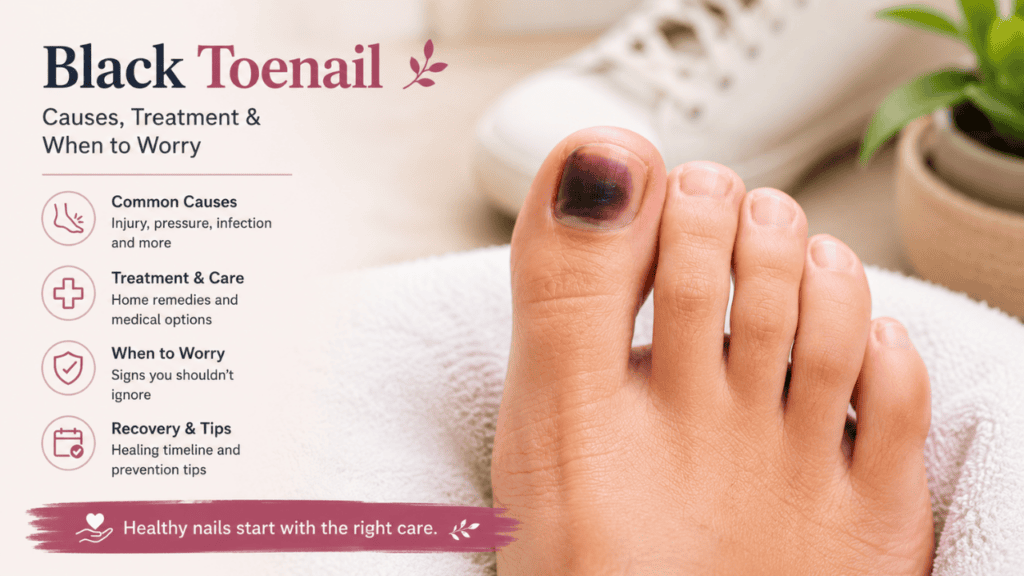
Have You Suddenly Noticed a Black Toenail?
What will be your first reaction when seeing a black toenail while removing your shoes? You’ll get all these common questions in your mind: “Is this fungus?”
“Blood clot?”
“Toenail remove aagiduma?”
“Any dangerous problem?”
But the important thing is that black toenails will not come for one reason.
Sometimes, when a heavy object drops on the toenail. In some other cases, running or hiking activities collect blood under the nail.
Sometimes, a fungal infection, repeated pressure from tight shoes, and, very rarely, serious medical conditions may cause black discoloration.
That’s why, don’t assume the worst after seeing the black nails, and at the same time, you should not ignore it either.
If you identify the correct reason, you can choose the right treatment.
In this guide, we will see, step by step, what a black toenail is, its common causes, how to manage it at home, and when to see a doctor.
What Is a Black Toenail?
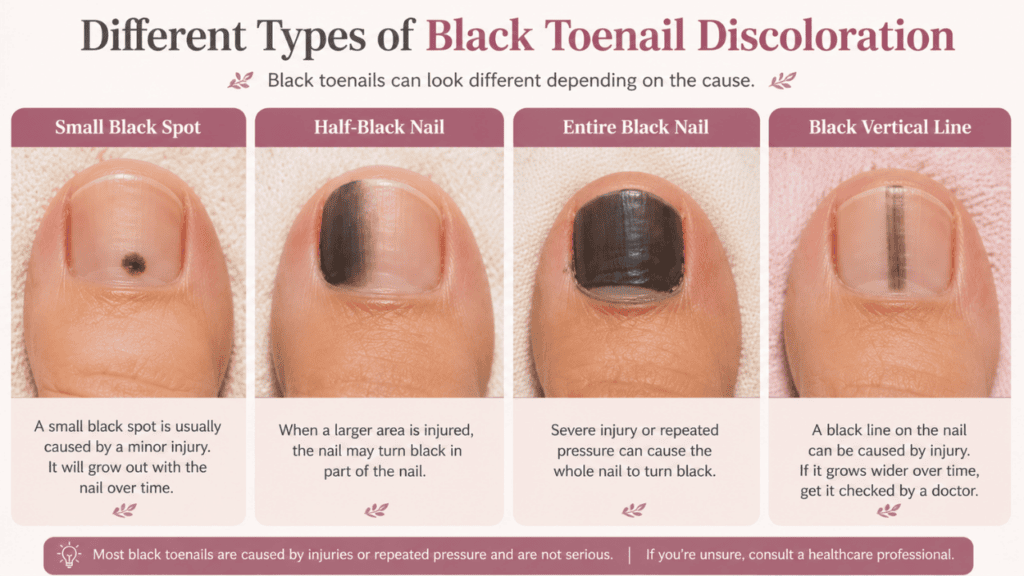
A black toenail is dark brown, dark purple, or black in color and can affect the entire toenail or a portion of it.
Sometimes the color will only be on the nail surface.
But in most cases, when blood collects under the nails, it appears black, a condition called a subungual hematoma.
Black discoloration will vary from person to person in size, shape, and location.
For example,
- That may look like a small black spot.
- Half a nail may look black.
- The entire toenail will be dark black.
- There will be a Black line stripe.
We cannot say the exact reason from the appearance, and you should not conclude from the color.
Is a Black Toenail Always Serious?
Not necessarily.
Actually, in most cases, the reason for black toenails is a minor injury or repeated pressure.
In some situations, black discoloration may also cause serious issues.
Especially,
- When the Black patch gradually increases.
- Color gets spread to the surrounding skin of the nails.
- Severe pain.
- You don’t have any history of injury, but you have a black spot.
You shouldn’t ignore these symptoms. Fortunately, most black toenails are not cancerous. But if you notice any unusual changes, the safest option is to have a doctor evaluate you.
Before Looking at the Causes, Observe Your Toenail Carefully
The Interesting thing is, the black toenail appearance will give some clue about the actual reason.
So, before thinking about treatment, start observing your nails.
Ask Yourself:
- Is the Black color on the entire nail or just a small spot?
- Do you have any Pain?
- Had any Recent toe injury?
- Doing running, gym, trekking?
- Do you have thick nails?
- Nail got loose?
- Does the color slowly move as the nail grows?
These simple observations help the doctor to diagnose. At the same time, you’ll find it easy to understand the next section of this article.
Sometimes, fungal infection, repeated pressure from tight shoes, and very rarely, serious medical conditions kooda black discoloration-ku reason aagalam.
What Causes a Black Toenail?
So, now you understand that a black toenail is not a disease.
Actually, the black discoloration may have several causes. Some reasons will be harmless, and in some cases, medical attention is necessary.
With that in mind, don’t come to a conclusion after seeing the black color; the first step is to identify the reason.
Let’s look at the most common causes.
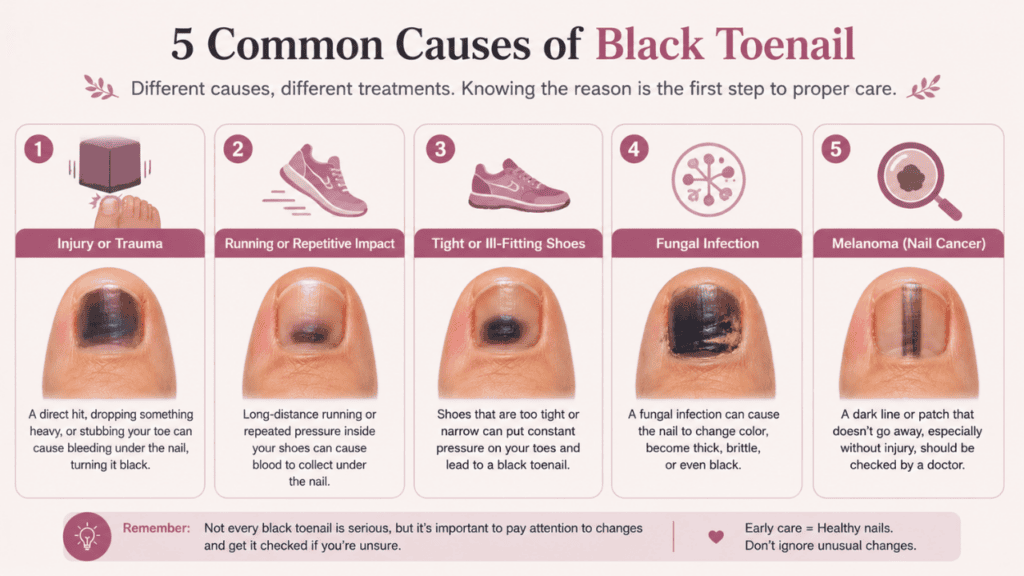
1. Injury to the Toe (The Most Common Cause)
For most people, a toe injury is the main cause of a black toenail.
Like,
- If any Heavy object falls on the toe.
- Toe got struck on the Door.
- You might have gotten hit forcibly on the Furniture edge.
In these situations, a small blood vessel is damaged, and blood collects under the nail. That’s why you see the black color under the nail; in medical terms, it is called a subungual hematoma.
Initially, the color may look like dark red or purple. After a few days, the color changes to dark brown or black.
Pain gradually increases over the first one or two days, and you may also develop swelling.
The Good news is that most minor injuries will settle on their own.
2. Repeated Pressure from Running or Sports
A black toenail is not solely due to injury.
Sometimes, small repeated pressure will create the same problem.
This is especially common among:
- Marathon runners
- Hikers
- Football players
- Tennis players
- People who spend long hours standing
When taking every step, the toenail will hit the shoe repeatedly. This will not feel like a single injury. But with continuous pressure, blood vessels will be damaged, and gradual black discoloration develops.
That’s why this black discoloration issue is also called “Runner’s Toe”.
If neither shoe is a comfortable fit, repeated friction may increase.
3. Tight Shoes
Even people who don’t run also get black toenails.
Sometimes the problem will be the shoe.
Using too-tight shoes, a narrow toe box, or an incorrect shoe size creates continuous pressure on toenails.
Initially, you may feel discomfort.
But if the daily pressure continues, the damage beneath the nail gradually develops, and the color changes gradually.
Especially if one toe repeatedly touches the front of the shoe, the nail will be affected first. Changing the shoe size will prevent problems in the future.
4. Fungal Infection
Most people will assume a black toenail is fungus.
Actually, fungi are not the most common cause of black toenails.
Usually, a fungal infection of the nail will start with these colors:
- Yellow
- White
- Brown
If the infection progresses, the nail may become thicker and more brittle, and gradually turn dark brown or even black.
In some cases, a fungal infection and a nail injury can occur simultaneously. When that happens, the discoloration may look even darker.
That’s why you shouldn’t assume that every black toenail is caused by a fungal infection.
Related Read: If your toenail is yellow instead of black, you may find our guide, “Why Are My Toenails Yellow?” helpful. It explains the common causes of yellow toenails, including fungal infections, and how to tell them apart from other nail problems.
5. Rare but Serious Causes
Fortunately, this is very uncommon, but it’s important to mention here.
In rare cases, subungual melanoma, which may develop under the nail, is a type of skin cancer that may appear as a black line or dark patch.
This will develop without any history of injury.
Especially if:
- The black mark slowly gets bigger.
- Spreading around the Nail surrounding skin.
- Color doesn’t disappear in some months.
- Nail shape is changing.
If you find these symptoms, it’s important to consult a doctor; don’t try any self-treatment.
Remember, most black toenails are not melanoma. But if you notice any unusual changes, it’s not the right approach to ignore them.
Quick Summary
How Should You Take Care of a Black Toenail?
Now we have seen the details about the reason for the black toenail.
The most important part is, what to do now?
The Good news is, you don’t need immediate treatment for most black toenails. Especially a black toenail from a small injury or repeated pressure; with little care, the toenail will recover gradually.
At the same time, not all black toenails can be managed at home; in some cases, consulting a doctor is very important.
That’s why you should understand what normal recovery looks like and when you need medical help.
If you regularly wear acrylic toenails, proper application and aftercare are important to keep your natural nails healthy. You can learn more in our guide on Acrylic Toe Nails: Benefits, Risks, Cost & Care.
Taking Care of a Black Toenail at Home
If your black toenail was caused by a minor injury and the pain is gradually improving, simple home care is usually enough.
Follow these simple tips for better Healing,
- Wear Comfortable shoes, so you won’t get extra pressure on your toes.
- Maintain clean and dry toenails.
- Avoid running, jumping, or repeated toe-pressure activities for a few days.
- Don’t try to force remove the Damaged nail.
On some days, you may feel the injured nails loosen; don’t panic at that.
In Most cases, the old nail gradually separates, and under that, new nails start to grow.
You need patience for the natural Healing process.
When Medical Treatment May Be Needed
Most black toenails gradually improve. But you should not ignore some warnings.
Seek medical advice if:
- Pain is not improving after a few days.
- Swelling increases.
- Pus or bad smell develops.
- Nails are turning black without Recent injury.
- Dark discoloration spreads to the nail surrounding skin.
- The black line gets gradually wider.
The treatment depends on the actual cause.
Sometimes, simply draining the trapped blood is enough. If a fungal infection is causing the problem, your doctor may recommend the appropriate treatment. If the reason isn’t clear, a few additional tests may also be needed before deciding on the next step.
Recovery Takes Time
Black color will not disappear overnight.
Even if the pain decreases, it will take several months for the damaged nails to return to normal.
Sometimes old nails gradually loosen and naturally fall off.
This doesn’t mean a serious problem. If the nail root wasn’t damaged, a new nail gradually replaces it.
Toenails grow slowly, and it’s normal for them to take time to fully recover.
So, don’t worry about the immediate changes for the first few weeks.
Simple Ways to Prevent Future Black Toenails
To reduce the risk of black toenails in the future, you have to make some changes to your daily habits.
- Choose a proper shoe size.
- Trim the Toenails straight.
- Replace the worn-out sports shoes.
- Wear protective footwear while handling heavy objects.
- Inspect toenails periodically if you run or hike regularly.
These simple precautions will help to avoid repeated injuries.

Frequently Asked Questions
Will My Black Toenail Fall Off?
Yes. Especially if you get a black toenail from a minor injury or repeated pressure, when the nail gradually grows back, the black area will slowly move out, and you can cut it.
But if the pain increases, there is swelling, or the discoloration doesn’t improve, it’s better to consult with a doctor.
How Long Does It Take for a Black Toenail to Heal?
It depends on the actual cause and the extent of the nail’s damage.
If the injury is severe, the pain will settle in a few days or weeks. But it will take 6-12 months for the new toenail to fully grow.
Toenails will grow more slowly than fingernails, so you need some patience.
Can I Paint Over a Black Toenail?
It’s better to wait until the nail has healed.
Applying nail polish may hide important changes in the nail. If the black discoloration is due to an infection or the exact cause is still unknown, it’s best to avoid covering it until the nail has been checked.
Should I Remove a Loose Black Toenail Myself?
No, don’t try to remove. Even if the old nail comes loose, it will act as a protective barrier for the new nails as they grow. If you force remove it, you’ll get unnecessary pain, bleeding, and an increased risk of infection.
It should be removed naturally, which is the safest option, too.
Can I Continue Running With a Black Toenail?
If you don’t have any pain, you can continue your activities normally after recovery. If you get pain while running, it’s better to rest.
Is Every Black Toenail Caused by a Fungal Infection?
No. Most black toenails are usually caused by an injury or repeated pressure on the toe, not by a fungal infection. However, if you don’t remember injuring your toe, or the discoloration doesn’t gradually grow out with the nail, it’s best to have it examined by a healthcare professional.
Final Thoughts
Finding a black toenail can definitely be worrying, especially if you don’t know what caused it.
The good news is that most black toenails are caused by minor injuries or repeated pressure, and they usually improve with time and proper care.
At the same time, don’t ignore unusual changes. If the pain keeps getting worse, the discoloration spreads, or you notice signs of an infection, getting medical advice early is always the safer option.
Most importantly, remember that toenails heal slowly. Giving your nail enough time to recover and protecting it from further injury can make a big difference.
With the right care and a little patience, most black toenails gradually return to a healthier appearance.
